



Why Your Existing Members Are Your Greatest Growth Opportunity

When credit union leaders talk about growth, the conversation often starts with acquisition. How do we attract younger members? How do we enter new markets? How do we increase membership? How do we convince consumers to choose us instead of a bank, fintech, or another credit union?
Those are important questions, but there is another growth question that deserves just as much attention: Are you maximizing the relationships you already have?
Credit unions collectively serve a massive audience. At the end of 2025, federally insured credit unions had approximately 144.7 million members, according to the National Credit Union Administration (NCUA). Yet industry-wide membership growth doesn’t tell the whole story. While aggregate membership increased, membership at the median credit union declined by 0.5% during 2025, and approximately 55% of federally insured credit unions ended the year with fewer members than a year earlier.
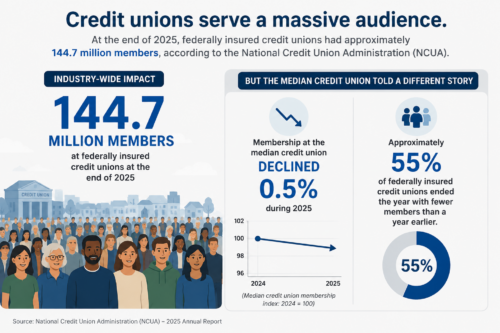
That creates an important distinction between adding members and creating growth.
Acquisition will always matter. But your credit union may already have thousands or hundreds of thousands of relationships with people who don’t fully understand or use everything you can do for them.
The next big growth opportunity may already be on your membership list.
Why Focus on Existing Members When We Need New Members?
Because membership alone doesn’t automatically equal engagement.
A member may have opened a savings account years ago and rarely interact with the credit union. Another may have a checking account with you but finance their vehicle somewhere else. Someone else may use your credit card but keep most of their deposits at another institution.
They’re all technically members. But are they fully engaged members?
This is where credit unions should begin thinking differently about growth. Instead of looking only at the total number of members, consider the depth of those relationships. How many members consider you their primary financial institution? How many products and services are they using? How often are you having meaningful conversations with them? Most importantly, do you understand what they need next?
Filene Research Institute’s Member Pulse research reinforces why this matters. Based on responses from more than 4,700 credit union members, the research found that members differ significantly in their financial circumstances, their motivation to seek help, and where they prefer to get that help.
In other words, you can’t assume members will come to you simply because they need something.
Sometimes you need to start the conversation.
What Growth Opportunities Are Already Inside Your Membership?
Think about what happens in the financial life of an average member over five, ten, or twenty years.
Members’ financial needs can change significantly over five, ten, or twenty years. Along the way, they may:
- Buy their first car
- Purchase or refinance a home
- Start or grow a family
- Consolidate or refinance debt
- Open or expand a business
- Renovate their home
- Build emergency savings
- Help a child open their first account
- Prepare for retirement
Every one of those moments can create an opportunity for the credit union to provide value.
The problem is that your credit union may never know those moments are happening.
Members don’t necessarily contact their financial institution before making every financial decision. If another lender, fintech, credit card company, or bank reaches them first with a relevant offer, the member may establish that relationship elsewhere, even when their credit union could have helped them.
This is why member engagement and growth are so closely connected. Growth isn’t simply about having more products available. It’s about creating enough meaningful interactions to understand when those products can solve a member’s problem.
Isn’t Digital Marketing Already Doing This?
A modern member engagement strategy can use many different channels, including:
- Email campaigns
- Social media
- Digital advertising
- Mobile and online banking messages
- Personalized website experiences
- One-on-one member conversations
Each channel has value. But digital communication doesn’t replace conversation.
A member might ignore an auto loan email because they’re not currently shopping for a vehicle. Six months later, they may suddenly need one. A generic home equity promotion might not mean much until that member starts planning a kitchen renovation.
Timing matters. The strongest engagement strategies use multiple channels and create opportunities to learn more about members, rather than simply sending them more promotions.
Filene’s Member Pulse program emphasizes this concept by helping credit unions go beyond basic demographics and product holdings to better understand what drives individual member behavior. Filene says this type of segmentation can help credit unions personalize engagement, deepen relationships, and grow balances.
The goal isn’t simply more communication. It’s more relevant communication.
What Does Member Engagement Have to Do with Loan and Deposit Growth?
Quite a lot.
Credit unions aren’t starting from zero. They already have relationships with people who borrow, save, spend, purchase homes, buy vehicles, open businesses, and make financial decisions every day.
NCUA data shows just how much activity exists across the industry. During 2025, federally insured credit unions’ total loans outstanding increased 4.6% to $1.72 trillion, while total system assets increased 5.4% to $2.43 trillion.
The opportunity for an individual credit union is to capture more of its members’ financial activity.
Consider how many growth opportunities may already exist within your current membership:
- A checking member may have their auto loan somewhere else.
- A longtime member may have their mortgage with another institution.
- A business owner may not know about your business banking solutions.
- A homeowner may not be aware of your home equity options.
- A member carrying high-interest debt may not know about your refinancing or credit solutions.
- A member with growing savings may not understand all of your deposit and savings options.
These aren’t necessarily sales opportunities waiting for a promotion, they’re members needs waiting to be discovered.
But you can’t address a need you don’t know exists.
That is why proactive engagement can become a growth strategy rather than simply a communications strategy.
Shouldn’t Members Reach Out When They Need Something?
Ideally, yes.
In reality, financial relationships have become fragmented.
Consumers can open an account from their phone, compare rates in seconds, finance a purchase at checkout, apply for a loan online, and move money between institutions without ever entering a branch. Credit unions are no longer competing only with the bank down the street.
That makes maintaining relationships more important, not less.
Filene’s current research on the next generation of member growth focuses specifically on strategies to attract, engage, and retain credit union members. Its research into younger consumers also suggests that financial relationships can evolve from opening an account to experimenting with multiple financial providers and eventually consolidating those relationships.
The question is: When members consolidate those relationships, will your credit union be the institution they choose?
That decision is influenced by what happens between major financial transactions. If the only time a member hears from you is when you’re promoting a product, the relationship can begin to feel transactional. If you’re consistently helping members understand their options and connecting them to useful solutions, the relationship becomes something different.
Does This Mean We Should Sell More Products to Existing Members?
There is a big difference between product pushing and needs-based engagement.
Traditional cross-selling starts with the product: We have a home equity loan. Who can we sell it to?
Member engagement starts with the member: What is happening in this person’s financial life, and is there something we can do to help?
Sometimes the answer may be a loan. Sometimes it’s a savings product. Sometimes it’s financial education, refinancing, a digital service, or simply directing the member to the right person at the credit union.
That approach is more consistent with the credit union mission because growth results from solving more members’ needs, not simply from increasing sales activity.
Filene’s research into member well-being similarly recommends tailored, data-driven strategies that account for differences in members’ circumstances, motivation, and preferences.
The better you understand the member, the more relevant the conversation can become.
What Prevents Credit Unions From Doing More of This?
Usually, it’s not a lack of desire. It’s a lack of capacity.
Credit union employees are already balancing responsibilities like:
- Serving members
- Processing loans
- Handling account questions
- Managing digital channels
- Supporting branches
- Meeting compliance requirements
- Working toward organizational growth goals
Meanwhile, consistent proactive outreach requires its own infrastructure, including people, technology, processes, training, data, reporting, and management.
That’s why an engagement strategy can look great on paper but become difficult to execute consistently.
Credit unions ultimately have several options:
- Build the capacity internally
- Use technology to automate parts of the process
- Work with an outside member engagement partner
- Combine internal resources, technology, and outside support
The right answer will vary by institution.
What’s important is recognizing that unused member potential is still an opportunity cost.
Acquisition and Engagement Should Work Together
None of these means credit unions should stop pursuing new members.
In fact, attracting the next generation remains one of the industry’s biggest challenges. Filene reports that fewer than 20% of Americans under age 40 currently use a credit union, underscoring why acquiring younger members remains strategically important.
But acquisition is only the beginning.
Imagine investing significant resources to attract a new member, successfully getting them to open an account and then barely communicating with them afterward.
That’s not a complete growth strategy.
A stronger growth strategy connects the entire member relationship:
- Acquire: Bring new members into the credit union.
- Engage: Learn what matters to them and what they may need.
- Expand: Connect members with relevant products, services, and resources.
- Retain: Continue providing value as their financial needs change.
Growth doesn’t stop when someone opens an account. That’s where the relationship begins.
Over time, one account can develop into a deeper, long-term relationship.
Your Next Growth Opportunity May Already Know Your Name
Growth doesn’t always require finding someone new.
Sometimes it means doing more for the people who have already chosen you.
Your members already know your name. They have already opened an account. They have already allowed your institution to earn their trust. The question is what happens next.
Are you waiting for them to come back when they need something?
Or are you proactively finding ways to remain part of their financial lives?
At The Family Security Plan, our member engagement approach is built around helping credit unions create more of those conversations. By proactively engaging existing members, credit unions can uncover needs, identify opportunities for their products and services, and reconnect interested members with the credit union.
Because the greatest growth opportunity isn’t always another market, another branch, or another acquisition campaign.
It may already exist within the membership you’ve worked so hard to build.
Table of Contents
- Why Focus on Existing Members When We Need New Members?
- What Growth Opportunities Are Already Inside Your Membership?
- Isn’t Digital Marketing Already Doing This?
- What Does Member Engagement Have to Do with Loan and Deposit Growth?
- Shouldn’t Members Reach Out When They Need Something?
- Does This Mean We Should Sell More Products to Existing Members?
- What Prevents Credit Unions From Doing More of This?
- Acquisition and Engagement Should Work Together
- Your Next Growth Opportunity May Already Know Your Name
Related Articles

Read more The Modern Member’s Financial Journey: How Credit Unions Can Walk Beside Them Every Step of the Way

Article
