Many People Overpay for Life Insurance – Here’s Why and How to Avoid It

Published on August 13, 2025

Article Written By: Lauren Hoeffel

What’s in this article? 

  1. The Hidden Reasons Behind Overpaying
  2. Tips to Avoid Overpaying

Life insurance is a foundational pillar of financial protection, yet many people unknowingly spend more than necessary on their policies. From poor product fit to misaligned coverage levels, countless families are overpaying for life insurance that doesn’t fully meet their needs or budget.

The good news? With a bit of education and guidance, you can avoid these common traps and ensure you’re getting real value from your investment in peace of mind.

The Hidden Reasons Behind Overpaying

1. Buying the Wrong Type of Insurance

One of the most common mistakes is purchasing a life insurance product that doesn’t align with your goals or stage of life. The two main types of life insurance are:

• Term Life Insurance: Covers you for a set number of years (e.g., 10, 20, or 30 years). It’s typically more affordable and ideal for temporary needs such as replacing income while raising children or paying off a mortgage.

• Whole Life (Permanent) Insurance: Covers you for life and builds cash value but comes at a significantly higher cost.

Many people buy whole life insurance without fully understanding its complexity or whether they actually need lifelong coverage. Unless you have estate planning needs or want to use the policy as an investment vehicle, you might be overpaying for features you won’t use.

2. Too Much Coverage

It’s wise to protect your loved ones, but being overinsured can strain your budget unnecessarily. Financial advisors typically recommend coverage of 5-10 times your annual income, but the right number depends on your specific financial obligations, such as:

• Outstanding debts

• Dependents’ future education costs

• Your spouse’s financial dependency

• Funeral and final expenses

Instead of opting for a large policy just because it’s offered, assess your true needs. A well-balanced policy should bridge the gap between affordability and protection.

3. Not Shopping Around

Many people purchase insurance through a single provider, often the one their employer partners with or a familiar household brand. However, pricing and underwriting guidelines can vary dramatically across carriers. A healthy 35-year-old could pay anywhere from $15 to $45 a month for the same $500,000 term policy, depending on the insurer.

Comparing rates from multiple providers-or working with a broker who does the shopping for you-can potentially save thousands of dollars over the life of the policy.

4. Relying Only on Employer-Sponsored Coverage

Employer-provided life insurance is a nice benefit, but it’s often insufficient. These group policies tend to offer minimal coverage (often just 1-2 times your salary), and they typically end if you leave your job. Some employees opt to “top up” through their employer’s additional coverage, but those supplemental premiums are often more expensive than individual policies in the open market.

In many cases, you can get more coverage for less by purchasing a personal policy outside of work.

5. Skipping the Health Exam Without Understanding the Tradeoff

No-exam or simplified issue life insurance is convenient, especially for busy people or those with health concerns. But that convenience comes at a cost-higher premiums and often lower coverage limits. These policies also frequently come with a waiting period before the full death benefit is paid.

If you’re in good health, taking the time to complete a medical exam can unlock significantly lower premiums. Over the life of a policy, the savings can be substantial.

The Psychological Side of Overpaying

It’s not just lack of information that leads to overspending-it’s also emotion. Life insurance is an emotionally charged purchase. It involves imagining death and trying to care for loved ones from beyond the grave. That emotional weight often drives people to buy more than they need or stick with the first product they’re pitched, just to get it over with.

Fear, guilt, and urgency often cloud rational financial decisions. That’s why it’s important to pause, assess, and plan before buying.

Tips to Avoid Overpaying

1. Conduct a Needs-Based Analysis

Before shopping for coverage, calculate your actual needs. A simple formula is:

[Outstanding Debts] + [Future Expenses (college, childcare)] + [Income Replacement Years] – [Current Assets and Other Insurance]

This gives you a starting point to determine the right amount of coverage.

2. Match Coverage to Your Life Stage

• Young families may benefit most from 20- or 30-year term policies that protect growing children.

• Empty nesters or retirees may need smaller final expense policies, not large death benefits.

• High net-worth individuals may require permanent insurance for estate planning.

Customize the product to your situation-not the other way around.

3. Shop With an Independent Broker

Work with someone who represents multiple insurance companies, not just one. Independent brokers can compare products, rates, and underwriting flexibility to find the best deal for your profile.

4. Reevaluate Periodically

Life changes-so should your life insurance. If you’ve paid off your mortgage, grown your savings, or your children are now financially independent, you might be able to reduce your coverage or shift to a more cost-effective product.

Policy reviews every 3-5 years can uncover savings opportunities or ensure you’re not underinsured either.

Real Cost Example

Let’s compare two hypothetical 35-year-olds buying $500,000 in coverage:
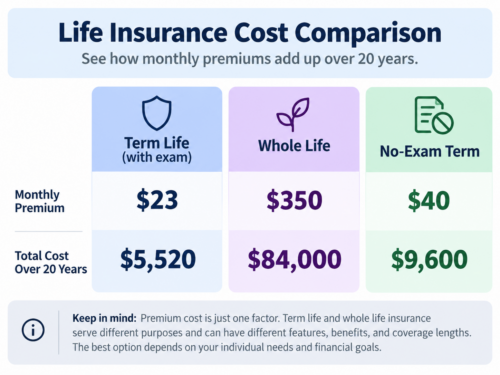
Unless you need lifelong coverage or have health issues that make exams risky, a traditional term policy offers vastly better value. Overpaying, even by $17 a month, adds up quickly.

Conclusion: Insurance Should Empower, Not Overburden

Life insurance is meant to give peace of mind-not create financial stress. Overpaying for coverage often stems from a mix of emotional urgency, lack of education, and insufficient comparison shopping. The result? Millions of families spend more than necessary, or worse, end up under protected and overbudget.

By understanding your needs, choosing the right product type, and reviewing your coverage over time, you can make smarter choices and get the most value from every premium dollar.

In the end, the goal isn’t just to have life insurance-it’s to have the right insurance at the right price.

Table of Contents
  1. The Hidden Reasons Behind Overpaying
  2. 1. Buying the Wrong Type of Insurance
  3. 2. Too Much Coverage
  4. 3. Not Shopping Around
  5. 4. Relying Only on Employer-Sponsored Coverage
  6. 5. Skipping the Health Exam Without Understanding the Tradeoff
  7. The Psychological Side of Overpaying
  8. Tips to Avoid Overpaying
  9. 1. Conduct a Needs-Based Analysis
  10. 2. Match Coverage to Your Life Stage
  11. 3. Shop With an Independent Broker
  12. 4. Reevaluate Periodically
  13. Conclusion: Insurance Should Empower, Not Overburden
Back
Product Assessment
0 % Complete
Close
Percent
What best describes your current life situation?
How old are you?
Are you currently employed?
What is your biggest financial concern if something unexpected happened?
Select all that apply
Empty Line
Which of these apply to your current situation?
Select all that apply
Empty Line
How long do you need coverage?
Would you like to cover anyone else in your family?
Select all that apply
Empty Line
How would you describe your lifestyle?
What matters most to you in an insurance plan?
What weekly budget are you comfortable with for insurance?
Almost there! Where should we send your personalized recommendation?
A Family Security Plan® specialist may also reach out to answer any questions.

    Privacy Policy
    overlay
    Leave the quiz?
    If you exit now, your answers won't be saved and you will need to start over next time.
    Back
    Coverage Quiz
    0 % Complete
    Close
    Percent
    What’s your age range?
    Do you support children, a spouse, or other family members?
    Have you had a big life change lately?
    What best describes your job situation?
    Do you or your spouse work in a high-risk job?
    (for example a firefighter, police officer, construction worker, etc.)
    How long could your household stay afloat if your income stopped?
    coverage quiz image 01
    Do you have emergency savings set aside?
    Do you have life or supplemental insurance through work or elsewhere?
    Will your insurance coverage continue if you leave your job or retire?
    Have you reviewed your insurance in the past year?
    Do you have any major debts?
    If something happened to you, could your family maintain their lifestyle?
    Are you concerned about losing income if you couldn’t work?
    What types of insurance are you open to learning more about?
    Select all that apply
    Empty Line
    What’s your monthly budget for coverage?
    Your Insurance Coverage Score is Ready!
    Enter your details below to view your complete results.

      Privacy Policy
      overlay
      Leave the quiz?
      If you exit now, your answers won't be saved and you will need to start over next time.
      Back
      Credit Union Health Score
      0 % Complete
      Close
      Percent
      Credit Union Health
      We innovate from within, embracing needed change with speed and implementing new ideas as part of a formal strategic plan.
      Are your ideas truly inspired from within your team? Does implementation happen, or do great ideas stall between inspiration and execution?
      0
      10
      Completely disagree
      Completely agree
      Credit Union Health
      Our third-party relationships are genuine strategic partnerships that advance our long-range and short-term strategies.
      Do your partners bring measurable value beyond their product or service, or do they simply fill a line item in the budget?
      0
      10
      Completely disagree
      Completely agree
      Credit Union Health
      Our leadership team holds itself and our teams accountable to clear, measurable goals, and everyone knows the numbers.
      Does the team know what is expected? Do they solve their own problems, or rely on the CEO to come up with solutions? Does everyone know and can recite the credit union's overall goals?
      0
      10
      Completely disagree
      Completely agree
      Channels Of Access
      We proactively reach out to our membership through outbound calling, email campaigns, and community outreach rather than waiting for members to come to us.
      Industry data shows only 30% of loan origination comes from proactive channels. Where does your credit union stand? Insurance is 95% proactive: how proactive are you?
      0
      10
      Completely disagree
      Completely agree
      Channels Of Access
      Our Business Development Team systematically visits employer groups and intentionally builds lasting relationships with key contacts throughout.
      Is your BD team held accountable to visits and results? Are contacts tracked continuously, not just when a position turns over?
      0
      10
      Completely disagree
      Completely agree
      Channels Of Access
      Our online and mobile banking, social media, and email marketing actively generate interest in products and services, pointing members toward educational content and referrals.
      Do you have your own content or do you pull from outside? Is it personalized and segmented by member life cycle, or are you still sending blanket messages to your entire membership?
      0
      10
      Completely disagree
      Completely agree
      Channels Of Access
      Our branches and contact center are optimized to educate members and generate meaningful cross-selling results, not just service transactions.
      How is cross-selling measured? Is it consistent across the team, or dependent on a few top performers? Does everyone know the numbers, and are those numbers celebrated?
      0
      10
      Completely disagree
      Completely agree
      Member Engagement
      We have a systematic outbound engagement program that builds trust before the call, uses member data to personalize each conversation, and produces measurable results.
      Is it truly systematic, or occasional and one-off? Do you warm up the call with personalized emails first? A program that runs occasionally produces occasional results.
      0
      10
      Completely disagree
      Completely agree
      Member Engagement
      Our member engagement conversations consistently lead to action - members participating in appropriate products and services - and we track and celebrate those results.
      What is the desired call to action on each engagement, and is it consistently measured? Are the actual results meeting the purpose of the program?
      0
      10
      Completely disagree
      Completely agree
      Member Engagement
      We measure the critical metrics of our engagement program - loan conversions, cross-sell results, retention rates - and use that data to make real decisions.
      Can you show the results of your engagement program right now in a report, not an estimate? A program without data is a program running on belief.
      0
      10
      Completely disagree
      Completely agree
      One last step.
      Your Credit Union Health Report is ready. Enter your information below and a Family Security Plan specialist will be in touch to walk through your results.

        Privacy Policy
        overlay
        Leave the quiz?
        If you exit now, your answers won't be saved and you will need to start over next time.